
Telangana is preparing for a major change in its education system. From the 2027–28 academic year, the state plans to replace the separate Intermediate structure with Classes 11 and 12 under the regular school education system. The move could affect admissions, examinations, junior colleges and subject selection across the state. It also comes as education systems across India increasingly focus on skill development, digital learning and career preparation. For context, students and parents can also read MadFoxy’s coverage of the CBSE examination QR-code controversy and its wider education and current-affairs coverage.
The announcement was made by Telangana Chief Minister A. Revanth Reddy during a review meeting with education officials. The proposed reform would bring Telangana closer to the 10+2 structure followed by CBSE and ICSE schools.
However, Intermediate education is not being cancelled overnight. The government has directed officials to prepare for the change, but the detailed rules are still expected.
What is Telangana changing?
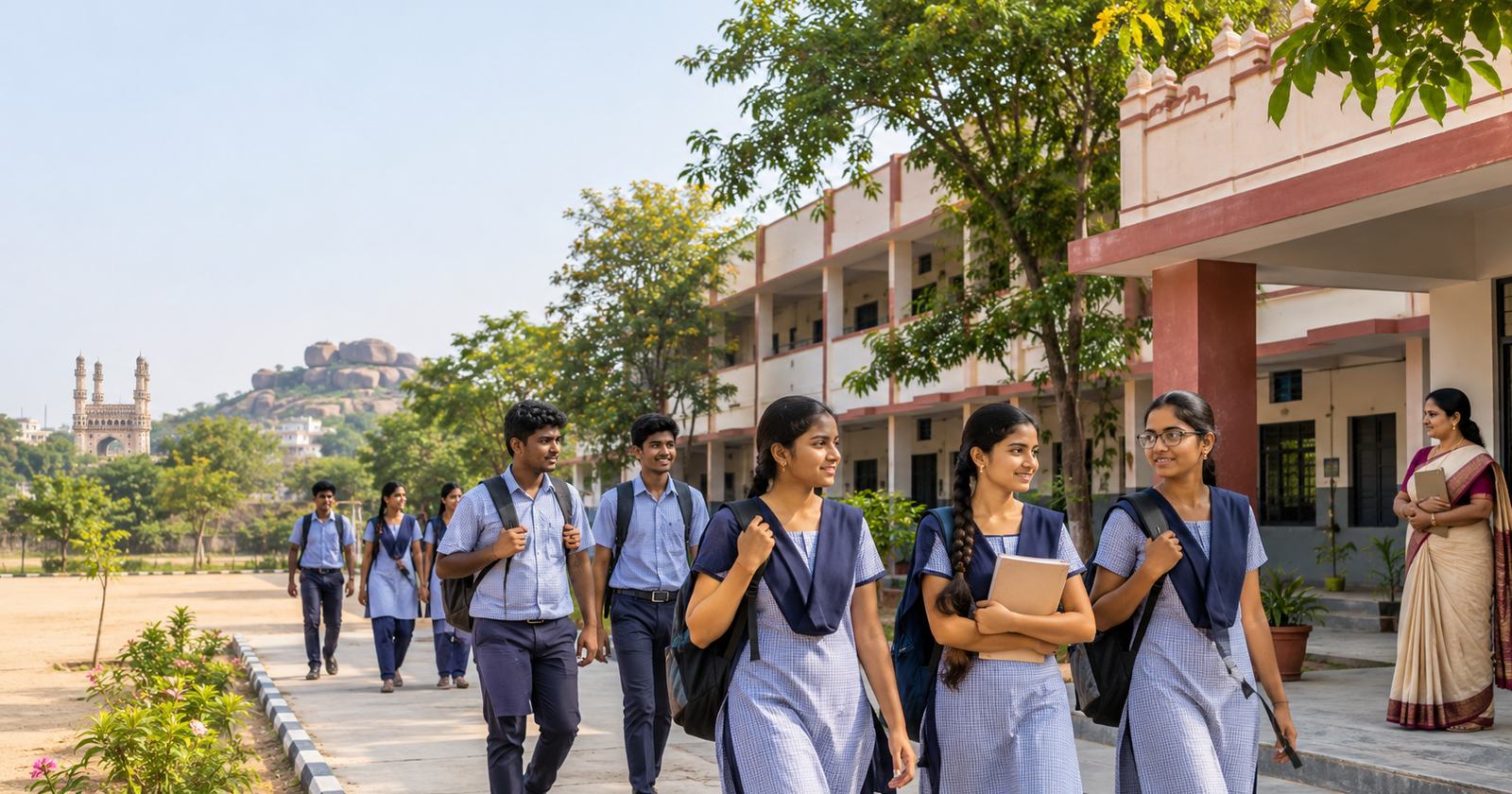
At present, students in Telangana generally study up to Class 10 in schools. After completing the SSC examination, they usually move to junior colleges for a two-year Intermediate course.
The current structure is divided into:
- Intermediate First Year, broadly equivalent to Class 11
- Intermediate Second Year, broadly equivalent to Class 12
Under the proposed reform, these two years would officially become Classes 11 and 12. Instead of treating them as a separate Intermediate stage, the government wants to bring them into the senior secondary school system.
This would create a more continuous education structure from primary school to Class 12. Students may be able to remain in the same school or education network for a longer period instead of moving to a junior college immediately after Class 10.
The plan is broadly similar to the structure already followed by CBSE and ICSE institutions, as well as several government-run residential schools.
When will the new system begin?
The proposed 10+2 system is expected to begin from the 2027–28 academic year.
This timeline is important because current students should not assume that existing Intermediate admissions have already been cancelled. Telangana had earlier decided to continue the existing admission process for the 2026–27 academic year because officials faced limited preparation time and technical difficulties.
The government will need time to decide how admissions, examinations, affiliations, certificates and teaching responsibilities will work under the new system.
Students and parents should therefore follow official notifications from the Telangana education department rather than relying on social media posts. The final rules may be released in stages.
Why is Telangana planning this reform?
One of the biggest reasons behind the proposal is the number of students who stop studying after Class 10.
According to reports following the Chief Minister’s meeting, a significant percentage of students leave formal education after completing secondary school. Girls and students from Dalit, tribal and minority communities are believed to face a higher risk of dropping out.
Moving from a school to a separate junior college can create several difficulties, including:
- Higher travel and accommodation costs
- Pressure on families to pay additional fees
- Lack of career counselling
- Difficulty finding suitable subject combinations
- Limited transport in rural areas
- Financial problems
- Reduced parental supervision
If students can continue Classes 11 and 12 in the same school system, authorities may be able to monitor attendance and academic progress more effectively.
The government has also referred to institutions such as Kendriya Vidyalayas, Jawahar Navodaya Vidyalayas and Kasturba Gandhi Balika Vidyalayas, where education is available up to Class 12 and dropout rates are comparatively lower.
What will happen to junior colleges?
The proposed reform does not automatically mean that every junior college will close.
Existing junior colleges could be reorganised, merged with the school education department or converted into institutions offering Classes 11 and 12. Private junior colleges may also receive new recognition or affiliation rules.
The government will need to clarify:
- Whether junior colleges can continue operating
- Whether schools will be upgraded to Class 12
- How private institutions will be recognised
- How science, commerce and humanities subjects will be offered
- Whether existing laboratories can be used
- How student transfers will be handled
- Which authority will conduct examinations
This will be particularly important because many Telangana students attend private junior colleges for specialised coaching in engineering and medical entrance subjects.
The reform must ensure that students do not lose access to laboratories, experienced lecturers or competitive-examination preparation.
Will the syllabus and examinations change?
The final syllabus and examination pattern have not yet been announced.
At present, students generally face major public examinations at the SSC and Intermediate levels. Under the new system, Class 10 and Class 12 examinations may continue, but their administration and structure could be changed.
The government may also reconsider whether Class 11 needs a separate public examination. Instead, students could be evaluated through school-level examinations and internal assessments before appearing for the Class 12 board examination.
This could reduce pressure on students, but internal assessment would need strong monitoring. Schools must follow transparent and consistent standards.
The new syllabus must also remain compatible with national entrance examinations. Students preparing for engineering, medicine, pharmacy, law and other professional courses will need a curriculum that does not leave them at a disadvantage.
Groups such as MPC, BiPC, MEC and CEC may also be reorganised or renamed. Students will need clear information before selecting subjects in Class 11.
What does the reform mean for students?
The proposal could provide several benefits.
Students may experience a smoother transition after Class 10 because they would not necessarily need to change institutions immediately. Schools could offer career counselling, language training and subject guidance before students make important academic decisions.
The government has indicated that Classes 9 to 12 may receive special attention. This could allow students to build communication skills, digital knowledge, vocational awareness and career-specific abilities.
Skill-based education may become increasingly important after Class 12. Students interested in creative and professional fields could explore options such as design, technology, media and entrepreneurship. MadFoxy has previously covered career-oriented education through its article on CAFD and CAD fashion designing courses.
The reform could also introduce more flexibility, allowing students to combine academic subjects with vocational or practical learning.
However, challenges remain. Many rural and government schools still require better laboratories, libraries, computers and specialist teachers. Merely changing the name from Intermediate First Year to Class 11 will not improve education unless the necessary infrastructure is provided.
What does it mean for parents?
Parents should not immediately change their children’s education plans based only on the announcement.
The proposed change is aimed at 2027–28. Until official rules are issued, the current admission and examination system should be treated as applicable.
Parents should seek clarity on:
- Where their child will study Class 11
- Which subject combinations will be available
- Whether the institution will offer Class 12
- How board examinations will be conducted
- Whether competitive-examination coaching will continue
- What fees and facilities will apply
- Whether transport or hostel arrangements will change
Parents should also pay attention to their child’s learning needs. Early education and language development can influence later academic performance. MadFoxy’s guide on helping toddlers develop early vocabulary is focused on younger children, but it reflects the broader importance of communication skills throughout education.
What happens to junior college lecturers?
The future of lecturers and non-teaching staff is one of the most sensitive parts of the proposed reform.
Junior college lecturers have previously raised concerns about their designations, promotions, transfers, salaries, pensions and retirement benefits.
The Chief Minister has indicated that the employment and retirement benefits of junior college lecturers and non-teaching staff will not be affected. However, the government will still need to issue detailed service rules.
The transition will require experienced teachers, particularly for advanced science, mathematics, commerce and language subjects. If Classes 11 and 12 are brought into schools, the government must ensure that teachers are available in both urban and rural areas.
Will this affect competitive examinations?
Students preparing for engineering, medical and other entrance examinations will be watching the reform closely.
Telangana’s existing Intermediate system is closely connected with competitive-examination preparation. Many students choose junior colleges specifically because they offer intensive coaching alongside the state syllabus.
The government must ensure that the new Class 11 and Class 12 system does not weaken preparation for entrance tests. The curriculum, practical classes and examination schedule should be designed in a way that supports both board examinations and national-level tests.
Students may also benefit if career counselling begins earlier. Instead of choosing a group based only on family pressure or coaching-centre advertisements, they could receive better guidance about higher education and employment options.
Digital education and online resources may also become more important. MadFoxy has previously discussed digital platforms through its article on advertising on ChatGPT, reflecting how technology is becoming increasingly connected with education, careers and communication.
A reform that needs careful implementation
Telangana’s plan to replace the separate Intermediate structure with Classes 11 and 12 could help reduce dropouts and create a more continuous education pathway.
It may also make the state’s system more consistent with CBSE and ICSE institutions. Students could benefit from better career counselling, earlier subject guidance and greater access to skill-based education.
However, the reform will succeed only if it is supported by proper planning. The government must invest in classrooms, laboratories, libraries, teacher training, counselling, transport and digital facilities.
For now, the key point is that Telangana is preparing to introduce the 10+2 structure from 2027–28. Intermediate education is not being abolished immediately, and current students should wait for official guidelines before changing their plans.
If implemented carefully, the reform could help more students complete Class 12 and prepare for higher education. If introduced without sufficient preparation, it could create confusion for students, parents, teachers and junior colleges.
The transition will therefore need clear communication, strong infrastructure and meaningful consultation with everyone affected.
Additional MadFoxy internal links used
- MadFoxy homepage
- CBSE exam QR-code article
- CAFD/CAD course article
- Early vocabulary guide
- ChatGPT advertising guide