
A new banking law has triggered a wave of concern online, with posts claiming that police may soon be able to access a person’s bank records without a court order.
The claim sounds alarming.
It also needs context.
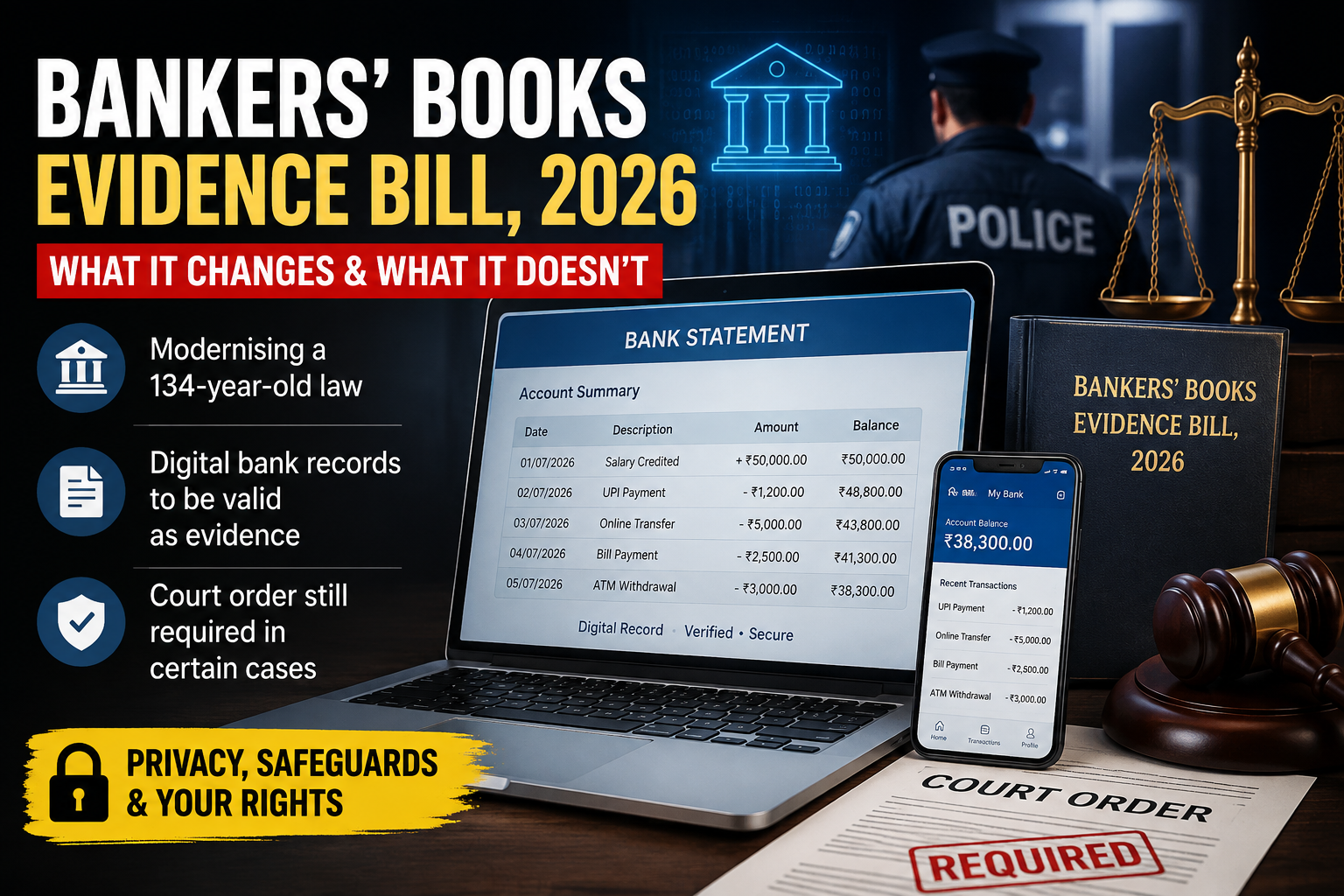
The Bankers’ Books Evidence Bill, 2026 was introduced in the Lok Sabha on August 3 and passed on August 5. The Bill seeks to replace the Bankers’ Books Evidence Act, 1891, a colonial-era law that governs how bank records can be used as evidence in legal proceedings.
The biggest change is not that police suddenly get unrestricted access to everyone’s bank account.
It is that the law is being rewritten for a banking system that now runs largely on digital records rather than physical ledgers.
According to the PRS Legislative Research summary of the Bill, electronic and digital banking records will be expressly recognised as legally admissible evidence, provided their integrity can be established.
That is important.
But so is what the Bill does not do.
What the Bankers’ Books Evidence Bill Actually Changes
The old Bankers’ Books Evidence Act dates back to 1891.
At that time, “bank records” meant things such as ledgers, cash books and account books physically maintained by banks.
Today, practically everything is digital.
Bank statements are electronic.
UPI transactions are recorded digitally.
Loan accounts are stored in databases.
Credit-card payments, transfers and account activity can be reconstructed through electronic systems.
The new Bill modernises the law so these records can be treated as valid evidence in legal proceedings.
Under the Bill, a digital or electronic copy of a bank entry can be accepted as evidence if certain safeguards are met.
The record must accurately represent the original information.
There must be no indication of unauthorised alteration.
And the integrity of the system storing that record must be maintained.
In simple terms, a bank cannot simply print a random spreadsheet and call it evidence.
The digital record still has to be reliable.
Can Police Access Your Bank Records Without a Court Order?
This is where the viral interpretation becomes misleading.
The Bill does not simply say police can walk into a bank and demand a customer’s entire account history whenever they want.
In fact, one of the protections contained in the old law has been retained.
A bank officer generally cannot be compelled to produce the bank’s books or appear as a witness in proceedings where the bank itself is not a party.
For such production to be compelled, there must be an order from a court or judge based on a special cause.
The new Bill even explains what “special cause” can mean.
According to the PRS explanation of the Bankers’ Books Evidence Bill, this can include situations where:
- the accuracy or genuineness of a bank entry is doubtful;
- something has happened that casts doubt on the regularity of record keeping; or
- the bank has failed to comply with a court order regarding inspection of its books.
So the idea that this Bill simply abolishes judicial oversight over bank records is not supported by the text described by PRS.
That distinction matters, especially when viral claims spread online faster than the underlying facts.
Why Is Everyone Talking About Police Access Then?
Because banking records can already become relevant during criminal investigations.
Police, investigative agencies and courts may seek financial records in cases involving fraud, money laundering, cheating, corruption or other offences.
The Bankers’ Books Evidence Bill primarily deals with the evidentiary status and production of banking records.
It is not a standalone law creating unlimited surveillance powers over bank accounts.
That does not mean privacy concerns are imaginary.
Bank data can reveal an enormous amount about a person.
Where you shop.
Who you send money to.
Your salary.
Your loans.
Your subscriptions.
Your travel spending.
Even small transaction histories can paint a surprisingly detailed picture of someone’s life.
That is why any law governing access to banking data deserves scrutiny.
But scrutiny should start with what the legislation actually says.
Digital Bank Records Become Much Easier to Use in Court
The more significant practical change is probably the formal recognition of electronic records.
Suppose an investigation involves a suspicious transfer made through online banking.
Under a modern banking system, there may be no physical ledger containing that transaction.
Instead, the evidence could consist of electronic entries stored in the bank’s systems.
The Bill explicitly recognises such electronic or digital records.
That makes evidentiary procedures better suited to today’s financial system.
It is a similar shift to what we are seeing elsewhere in India, where financial systems are moving aggressively toward digital infrastructure, from UPI payment reforms to automated government financial services.
The law is essentially catching up with technology that banks have already been using for years.
Why Replace a Law From 1891?
Because the banking system of 1891 and the banking system of 2026 have almost nothing in common.
The old Act was designed around physical books.
The new Bill recognises:
- digital records;
- electronic databases;
- electronic copies;
- modern banking systems; and
- the need to establish authenticity and integrity of digital evidence.
The Bill largely retains the framework of the old law while updating the definitions and evidentiary rules.
That is a key point.
This is less a completely new surveillance law and more a modernised evidence law.
The LiveLaw report on the Lok Sabha passage notes that the Bill was passed by voice vote on August 5 and replaces the 1891 Act.
The Government Can Extend the Law to Other Financial Entities
There is, however, another provision worth watching closely.
The Bill allows the Central Government to extend its provisions to other entities or classes of entities operating in the financial sector through notification.
That could potentially broaden the scope beyond traditional banks.
Exactly how far that power is used will depend on future notifications.
This is where the legislation becomes more interesting from a privacy perspective.
India’s financial ecosystem is no longer just banks.
There are fintech platforms, digital lenders, payment companies and other financial intermediaries processing enormous amounts of user data.
As the government increasingly modernises financial regulation, consumers are already being asked to understand changes ranging from EPFO digital withdrawals to new payment frameworks.
The ability to extend evidentiary provisions to other financial-sector entities therefore deserves attention.
Does This Mean Your Bank Account Is No Longer Private?
No.
The Bill does not convert everyone’s transaction history into public information.
Nor does it allow random individuals to request another person’s banking records.
Banking information remains protected by other laws, regulations and confidentiality obligations.
What the Bill does is specify how bank records can be produced and relied upon as evidence when they become relevant to legal proceedings.
That said, consumers should always pay attention when governments expand the legal treatment of digital records.
Digital evidence is much easier to store, search, copy and analyse than physical ledgers ever were.
That creates obvious benefits for investigations.
It also creates privacy risks if safeguards are weak or access powers are misused.
The balance between those two interests will determine how the law is viewed in practice.
Why the Viral Headline Is Too Simplistic
“Police can access your bank account without a court order” is the sort of headline that spreads immediately.
The actual Bill is much more boring.
And much more nuanced.
The law modernises how banking records are recognised in court.
It preserves restrictions on forcing banks to produce their books.
It defines circumstances where a court or judge can order production.
And it creates a framework for electronic records that simply did not exist when the original law was passed 135 years ago.
That doesn’t mean people should ignore the legislation.
Financial privacy is important.
India is already dealing with questions around large financial institutions, including concerns over how retirement money is invested and protected and how digital payment infrastructure is regulated.
But there is a difference between asking legitimate privacy questions and assuming the most alarming interpretation of a screenshot is automatically true.
So, Should Bank Customers Be Worried?
The better response is awareness, not panic.
The Bankers’ Books Evidence Bill, 2026 does make digital banking records more formally usable as legal evidence.
It also allows the government to potentially extend the framework to additional financial-sector entities.
Those changes deserve scrutiny.
But the claim that police now have blanket permission to access everyone’s bank records without judicial oversight is not an accurate summary of the Bill.
The protection requiring judicial involvement for compelling production of bank books in certain circumstances remains part of the framework.
For consumers, the real issue to watch is what happens after the Bill becomes law.
How broadly will “financial sector entities” be defined?
What safeguards will accompany digital records?
How will authenticity be verified?
And will future rules expand access beyond what Parliament is currently discussing?
Those questions matter far more than a viral social-media card.
Because modern financial laws are increasingly being written around data.
And once practically every payment, loan, salary credit and investment exists as a searchable digital record, the rules governing who can access that data become just as important as the money itself.
FAQs About the Bankers’ Books Evidence Bill, 2026
What is the Bankers’ Books Evidence Bill, 2026?
It is a Bill that seeks to replace the Bankers’ Books Evidence Act, 1891 and modernise how banking records are used as evidence in legal proceedings.
Has the Bill been passed?
The Lok Sabha passed the Bill on August 5, 2026. It still has to complete the remaining legislative process before becoming law.
Can police now access anyone’s bank account without a court order?
The Bill does not create blanket permission for police to access everyone’s bank records. It retains protections around compelling banks to produce records and recognises judicial orders in specified circumstances.
What is the biggest change in the Bill?
One of the most important changes is explicit recognition of electronic and digital bank records as valid evidence, subject to authenticity and integrity conditions.
Can digital bank statements be used as evidence?
Yes. The Bill provides for electronic and digital copies of banking records to be admissible if they accurately represent the original data and have not been tampered with.
Does the Bill apply only to banks?
It applies to banking entities covered by the framework, but the Central Government may also extend its provisions to other entities or classes of entities operating in the financial sector.
Does this make bank accounts public?
No. The Bill concerns the use and production of bank records as evidence. It does not make customer banking information publicly accessible.
Why is the 1891 law being replaced?
The existing law was written for an era of physical ledgers and paper banking records. The 2026 Bill updates the framework for modern electronic and digital banking systems.
Meta Title: Bankers’ Books Evidence Bill 2026: Can Police Access Bank Records?
Meta Description: The Bankers’ Books Evidence Bill 2026 modernises digital bank evidence. Here’s what it changes and whether police can access records without a court order.
Slug: bankers-books-evidence-bill-2026-bank-records-police-access